
“The story is always, ‘Half the kids died [of diseases].’ [And] I don’t think it’s true…”
A horrific and unexpected discovery in the context of measles in Fiji in the 1870s
Dear Church Leaders (and everyone else)
As I was writing a forthcoming article, I revisited part of this post…

…which featured the final part of a fairly long interview with diagnostic pathologist Dr Clare Craig. And I thought it worth highlighting part of that discussion, which comes in the context of the question of the extent to which vaccination has improved health outcomes (or not).
The main subject here is not vaccination though. The focus of the discussion is other medical treatments that were commonplace around 100 to 200 years ago.
The interviewer is Will Coleshill.
“25% of the Fijian population died in a 4-month period in 1875”
[Craig] The question [of health outcomes in relation to vaccines generally] has led me down into writing a new book actually, which I must get finished this year, because it matters… It’s a book about measles, and measles in Fiji in particular… [Almost] nobody cares about this, but I really care about this…
150 years ago, 25% of the Fijian population died in a 4-month period in 1875, and it was described as being because of measles. And that bothers me a lot, because that’s awful. That’s a really horrific massacre of people.
And I was looking at it and thinking, “Well, this doesn’t really add up with what we know about measles.” It’s not possible to kill a quarter of a population. So I’ve been digging into that, and I have learned an awful lot along the way. And the conclusion that I’ve reached is that, again, that was a drug-related massacre.
At the time, the Fijian health care system was largely missionaries who were doing their best… some with and some without medical training. But medical training in 1875 was not what it is now. And… what we described as a disease is not what it is now. And… the treatment… was mercury [compounds]… So people were taking mercury, and they died, almost all… Not of pneumonia or of an encephalitis, which is… how measles kills people. They died of dysentry. They had bloody diarrhoea [i.e. diarrhoea containing blood], and that is what killed them.
The way that people thought about diseases has changed over time… [These days] we will say, “If you’ve got this collection of symptoms, and you’ve got this evidence of this virus, we’re going to call that measles.” But then there was this idea of… “That was a nasty measles you got there, with a bloody diarrhoea”, where it might start off looking like measles, but literally any symptom could be added to that picture, and you would just say, “That was a particularly different type of measles”, which we wouldn’t do now. So you can look back at this historical documentation with our current diagnostic framework and say, “Look, that was measles plus, and the plus was the mercury.” And there’s another level to that story, but I’ll do that in the book for people…
But ultimately… the other aspect of it I suppose is that we are told all of the time that the big public health breakthrough that stopped children dying globally was sanitation. That’s always the story, isn’t it? Sanitation… that’s what cured… that’s what saved lives.
I wonder how many people think that it was mainly vaccination that resulted in the remarkable reduction in mortality rates from diseases between the time of the Crimean War and World War II… a notion that is — to say the least — difficult to reconcile with historic data such as this:

“I think mercury is what actually killed people”
[Craig] And I think [sanitation] would have absolutely had an impact for diseases that are spread through water like cholera… But I think the bigger impact was nothing to do with sanitation, because if you look at the trajectory of all these illnesses… the ones that spread through the air and the ones that never had a vaccine [at that time]… typhoid, diphtheria and scarlet fever and measles… these were all killing babies and children, they all fall at the same rate… as they stop giving mercury. And I think mercury is what actually killed people.
As noted in the above diagram, there is no vaccine for scarlet fever.
[Coleshill] So mercury was the big killer…
[Craig] [It] absolutely was. It was mercury…
[Coleshill] Wow… That’s a bombshell… Did you have this idea yourself…?
[Craig] I’ve been working on it over the last… few months. And that is the conclusion that I have reached… that massive drop in mortality that you see from 1850 to 1900… that was before any of the other excuses for a drop in mortality… came with skepticism around mercury…
They were still giving mercury after 1900, and particularly [to] pregnant women actually. And they were still giving it right up until antibiotics became something you could give instead. And so, for example, teething babies in the 1950s were still being given mercury. And then that became a scandal… I think that was really the last point when it… hit… “Enough now…” And they… stopped.
But it was never expressed openly. It was this… quiet scepticism… There were some doctors saying it. They never got a big platform… But [the amount of mercury given was] quietly reduced, and [people] stopped dying.
Dissenting doctors never got a big platform. But the drug given was quietly reduced, and people stopped dying.
I wonder how often that has happened over the course of history. And how much it still happens.
“I think nutrition probably… played a role [in improving mortality rates], but I think [stopping the use of] mercury’s the biggie”
[Coleshill] Wow… a lot of people say it [was] nutrition that improved… so… the factors would have been combined… that led to the drop in diseases…
[Craig] Yes. I think nutrition probably has played a role, but I think mercury’s the biggie… One of the things that was absolutely mind-blowing to me is that when you look at pre-Victorian death rates you start to get onto much… dicier territory in terms of the evidence, because you haven’t got… mortality bills that we had…
We had great mortality data from a long time ago in this country, but you go back a bit further and you’re like… “I’m not so sure now…” But you do have archaeological digs where they can look at bones. And they’ll dig up burial sites from pre-history… thousands of years ago… And you can… get this idea of… what was mortality like before mercury… And say, “Well, what was the baseline?” And the official answer is, “Well, half the kids died in childhood [of diseases].”
But it’s not as clear-cut as that at all, because if you go to, say, ancient Israeli sites, and you dig them up, [only] 10% of the bones are children’s bones. And you’re like, “Well, hang on a minute, if 50% of children are dying… and if you’ve got a stable population that’s not growing… then half of the bones should be children’s bones… that’s how it would work out.”
But that’s not what happens… You might have a growing population, but if you’ve got a growing population there should be even more children’s bones. But what the archaeologists convince themselves of is that the smaller bones get lost. And so you think, “Well, actually there might be some truth in that…” They’re saying, “Well… if you die as an infant you wouldn’t necessarily be buried with the adults… you might be buried at the home… there were different traditions around that.” So [perhaps] there’s some truth in it. And also, baby’s bones might get lost or damaged over time…
[But] then I said “Okay, let’s look at teenagers because teenagers are big. They… ought to disappear at the same rate as as adults.” And they were claiming that the teenagers were disappearing at higher rates. I’m like, “You’ve lost me now. I think you’re just lying.”
“The story is always, ‘Half the kids died [of diseases].’ [And] I don’t think it’s true…”
So I think that ultimately the truth is that historically… babies and children did not die at these ridiculous rates. And then [in the 1800s] we gave them all mercury, and they died for a period…
[Coleshill] And that’s the start of our data, so that’s the baseline… they’ve been using… that’s what they consider to be normal for the past.
[Craig] The story is always, “Half the kids died [of diseases].” [And] I don’t think it’s true…
[Coleshill] [looking understandably shocked] The amount of people who died [from mercury poisoning]… That’s millions… insane… it’s horrific…
[Clare Craig] It’s absolutely horrific…
[Coleshill] Do you ever start crying… finding this out?
[Craig] It can be an emotional thing, but mostly I try to do it as a pathologist. I’m putting on that hat.
[Coleshill] You’re used to it…
[Craig] I’m analysing it… I’m just trying to get to the truth. And the thing is that it’s really important, because although this is history… we’re living with it today, because this fear of infectious diseases is driving the pandemic preparedness industry. It’s driving this whole idea that we have to do this and we have to do that, or we’re all going to die. But this “We’re all going to die” thing… it’s just not based in evidence at all. And the fears of these diseases being able to spread and kill people is based on a time when people were dying of poisoning, or being made sicker…
If you have mercury, it will suppress your immune response. So you’re going to be more susceptible to the disease that you’re trying to treat… It’s counterproductive But also there’s an additional problem with mercury, which is that the drug that they loved giving was a drug called calomel… which was was two mercury atoms and two chloride atoms… [Hg2Cl2 — also known as mercurous chloride or mercury(I) chloride]
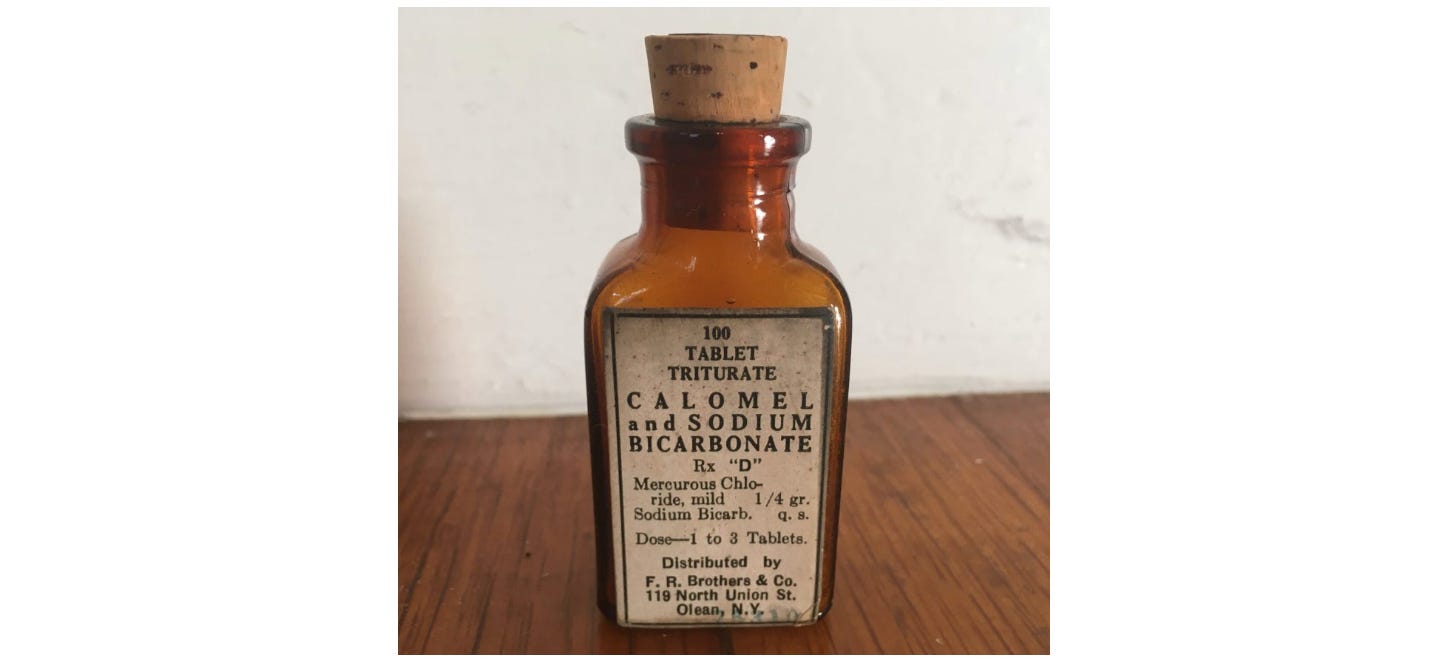
[Craig] But over time, and particularly in heat and humidity, one of those [mercury atoms] would drop out and it would become one versus two. [Hg2Cl2 → HgCl2 + Hg, i.e. giving HgCl2 — also known as mercuric chloride or mercury(II) chloride — plus elemental mercury Hg(0)1]
[And] this other compound [mercury(II) chloride] that is created over time… is really toxic… like 20x higher fatality. So when you go back to Fiji, the people [there] were being given a drug that had… come from the UK on a boat. And if it had been near the engine room for the journey [or just exposed to light]… [it’s] absolutely possible that you would get batches arriving in Australia and the Pacific that were really toxic.
But the thing is that it’s a batch effect… these people were used to taking calomel… They [would] take it all the time for everything because it was the only thing that they had. And it would “purge them”… that’s what they thought… They believed that… illness was inside… you had to detoxify… you’d take this stuff and it would cause you to empty in a way that wasn’t necessarily diarrhoea… So you would take that drug, and you’d think, “Well that’s what will happen…” But then you get a toxic batch, and you take that, and you start bleeding with diarrhoea. [And] you’re like, “Oh no, I’ve got sicker from the disease I’m trying to treat…” You don’t make the link [with the toxic drug]…
[Coleshill] That’s “the badness coming out”… That’s the way they interpret it.
[Craig] Yes, so they didn’t make the link with the drug because they trusted the drug to be consistent in a way they didn’t trust the disease to be…
[Coleshill] Wow… That is a huge number of people who’ve suffered from that… the amount of children…
“By your [pharmakeia] all the nations were deceived” (Revelation 18:23)Not unrelated:


Dear Church Leaders (and everyone else) homepage
Some posts, including a version of this one, can also be found on Unexpected Turns
Revealing Faith: Seeing and believing the revelation of God
The Big Reveal: Christianity carefully considered as the solution to a problem
Hg being the chemical symbol for the element mercury, from its Latin name hydrargyrum, itself from Greek hydrárgyros, ‘water-silver’; the conversion of Hg(I) to Hg(II) and Hg(0) is an example of a disproportionation reaction