
Dear Church Leaders (and everyone else)
I am conscious that many articles on this Substack focus on highlighting problems rather than advancing solutions. And, not least as Christmas approaches, I thought it worth putting out a few posts which, one way or another, discuss potential ways forward.
The context for this article is recent developments in Great Yarmouth, a seaside town in the east of England…
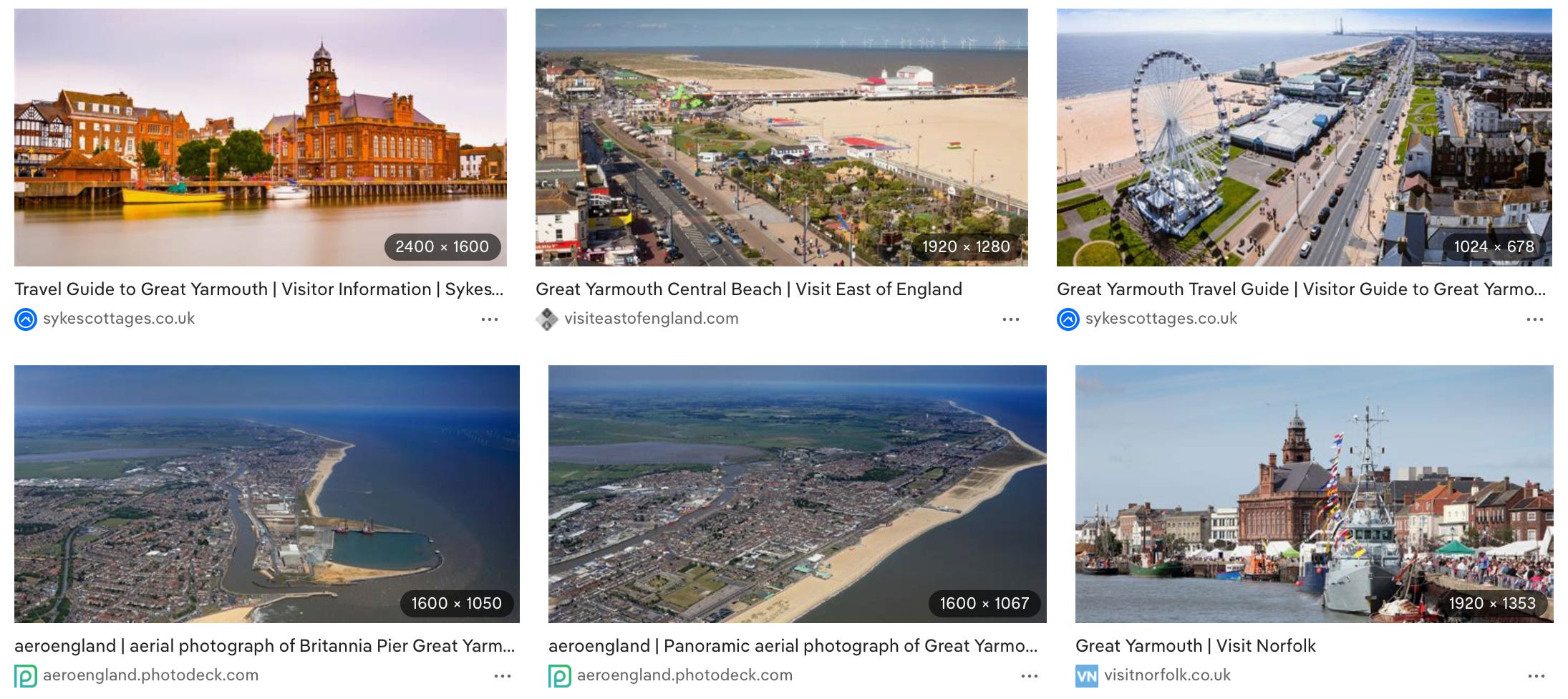
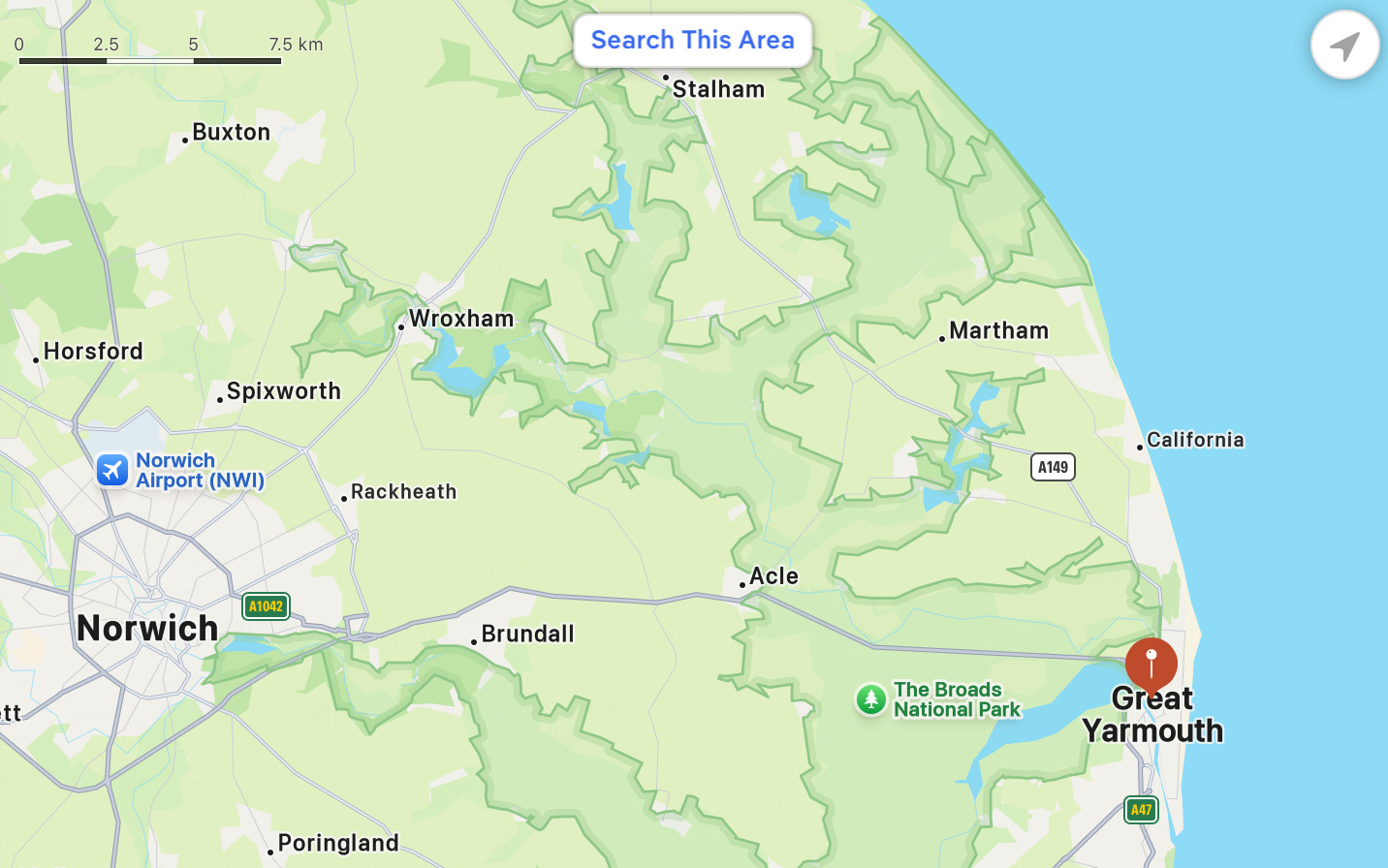
…six miles south of the little-known Norfolk village of California:
The local Member of Parliament is Rupert Lowe, who was elected last year as one of a handful of Reform MPs, but who has since been suspended from the party, and now sits as an independent.
According to the Great Yarmouth Mercury (which I am rather more inclined to trust than any member of the Trusted News Initiative):
Mr Lowe… believes he is being subject to a “witch hunt” after he criticised [Nigel] Farage’s leadership of Reform… saying it needed to change from being a “protest party” led by a “messiah figure”.
According to the same article:
[Lowe] vehemently denies the claims and accused the party of “a smear campaign” and promoting “an entirely false and poisonous narrative”.
And:
Asked whether he would consider setting up a rival party to Reform, he said: “I will not be quitting as an MP.
“I will continue to fight for the good people of Great Yarmouth. I sincerely appreciate all of their support.”
The 67-year-old added: “I have been subject to a malicious smear campaign, which has now finally emerged based on allegations that are not even about me. As I have said from the beginning, I am innocent.”
“My responsibility is not to Reform or Nigel Farage. It’s my constituents and my country. They will always be my sole priority.”
More recently, the Mercury has reported that the Great Yarmouth Reform branch has disbanded in support of their MP:
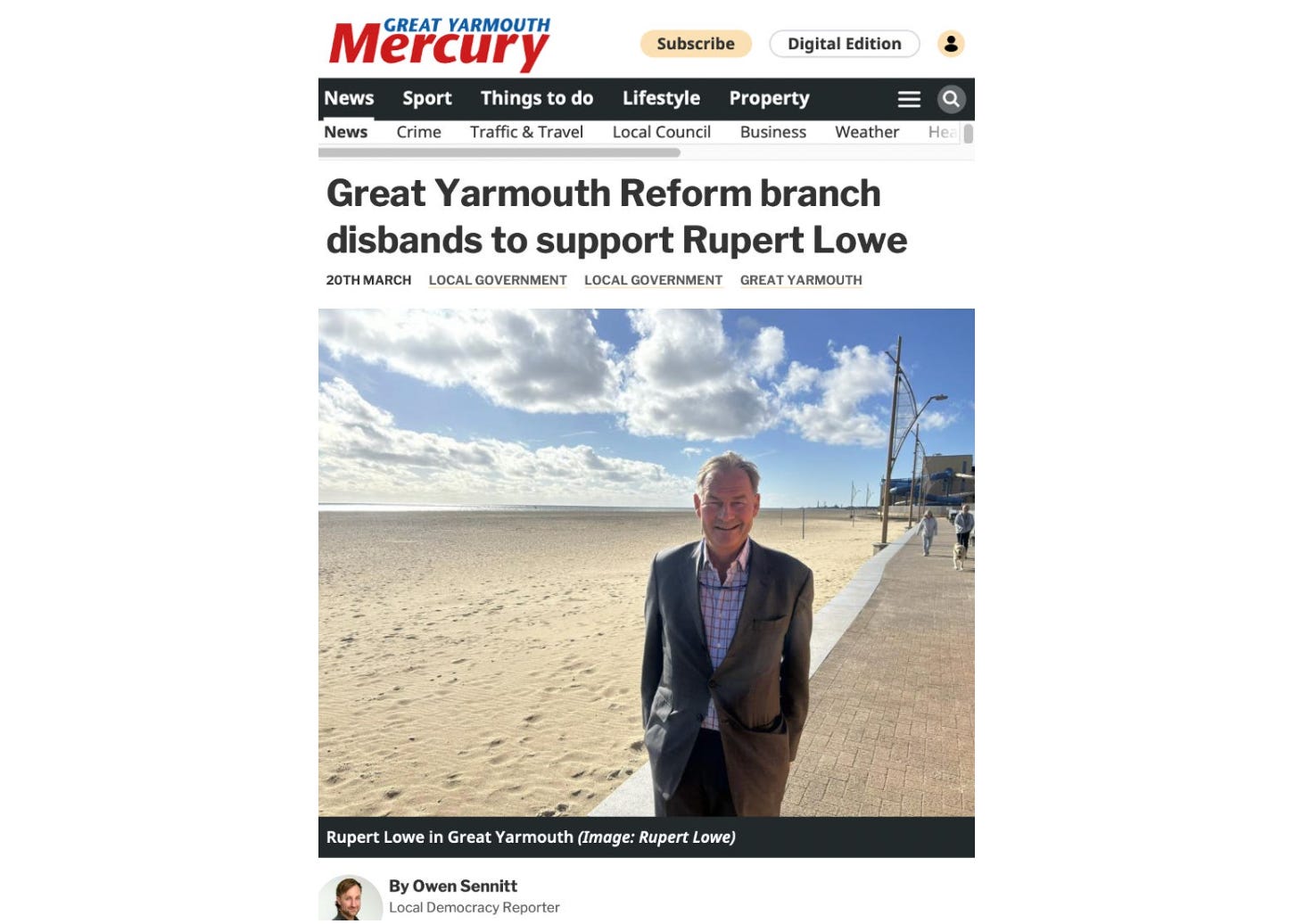
Reform members in Norfolk have quit the party in protest at the ousting of Rupert Lowe.
The Great Yarmouth branch has said they can “no longer support” Nigel Farage’s party after the town’s MP had the whip removed following allegations surfacing about his behaviour.
In a post on X (formerly Twitter), a spokesman called the treatment of Mr Lowe “disgraceful” and said members will continue to support him.
The spokesman said: “Rupert is a good man and the best, most proactive MP our town has ever seen.
“All of the local branch officers can no longer support Reform following the leadership’s disgraceful treatment of our MP.
“Rupert has supported our community. Our community now supports him.”
And that Lowe has launched a new political party:
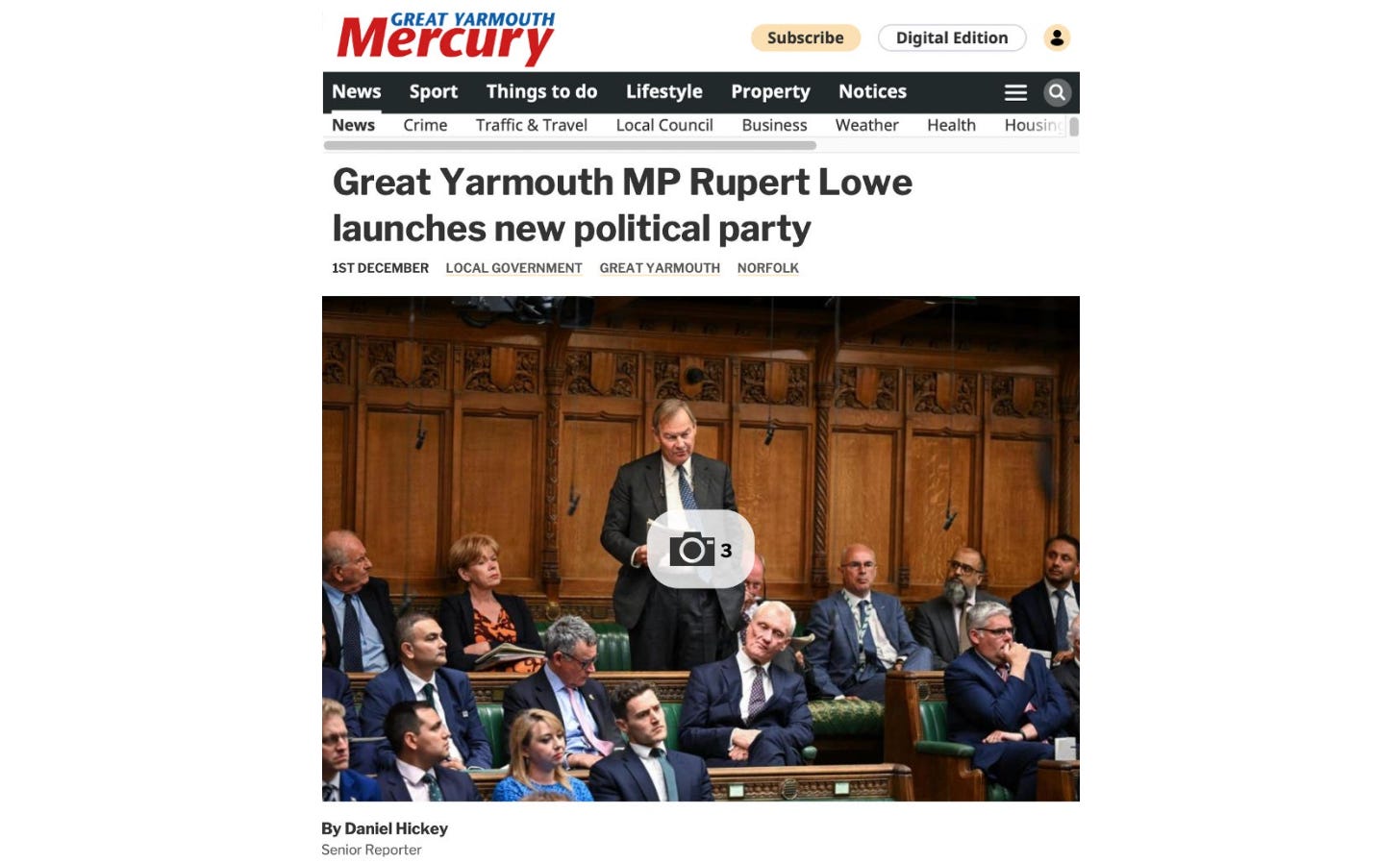
A Norfolk MP has launched a new political party nine months after he was expelled from Reform UK.
Rupert Lowe, Great Yarmouth’s independent MP, announced on Monday, December 1, the establishment of Great Yarmouth First.
He said the party was “designed solely to promote the interests of the Great Yarmouth constituency and its residents”…
Mr Lowe said: “Look at what national party politics has achieved for Great Yarmouth, just look around. It has failed our community. Again and again.
“It is time for something entirely new, something that is completely focused on doing what is right for Great Yarmouth. Not what is right for Norwich or London, but what is right for Great Yarmouth.
And here is a recent report from Owen Sennitt — the Great Yarmouth Mercury’s Local Democracy Reporter — on a poll of 121 locals suggesting that Great Yarmouth First could beat Reform:
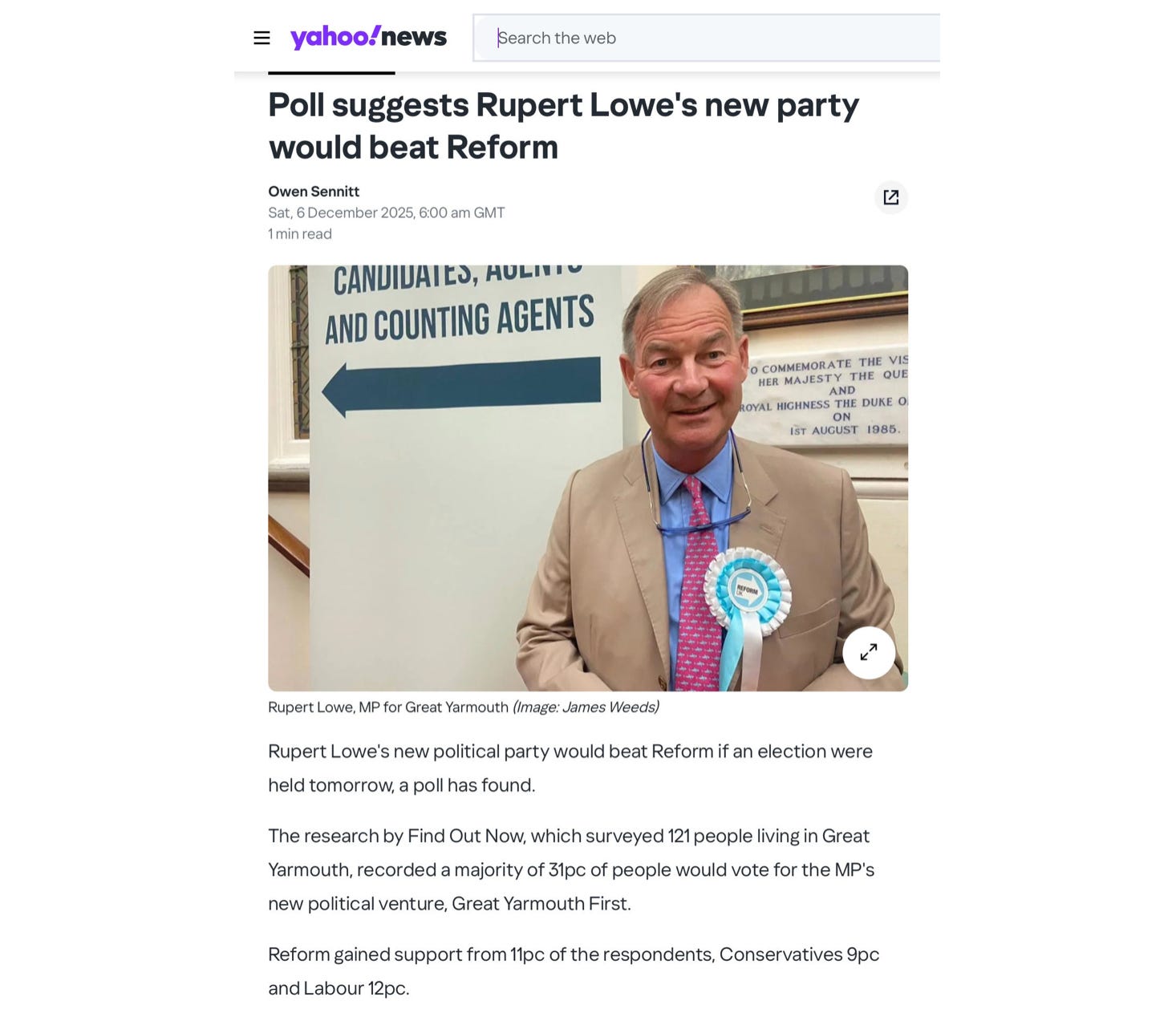
While I have some reservations about Rupert Lowe,1 I am intrigued to see what has happened in the context of his criticism of Farage and Reform, which, as I discussed here…

…does not look like a genuinely anti-establishment party to me.
But in any case, the way that we currently do politics could surely be improved. And Lowe’s initiative looks potentially interesting. A single-constituency party would provide something resembling an “official independent” candidate. I am reminded of what I wrote here…

…a couple of months before last year’s general election, and being pleased to find that there was an independent candidate in my constituency.
In a recent video (transcript below), Katherine McBean explains more about the idea of decentralisation. For context, she is the founder of the People’s Health Alliance and the People’s Health and Farming Alliance:
Introduction
Today I’m going to talk to you about decentralisation… and why I think it would be so beneficial for our country… I absolutely think it’s the way forward in terms of solving the issues that we currently have. I was inspired to do this [talk]… on the back of [Rupert Lowe’s] announcement about his Great Yarmouth party. What I want to do is… briefly… go through what we’ve got… what I think we should have and… the benefits of that… and why Rupert’s model… what he’s doing with the Great Yarmouth party would help to achieve [what] we want to achieve…
As we’re all becoming increasingly aware, we are controlled by centralised systems… central government… DEFRA… the NHS… national organisations [exerting] control from a centralised position… The NHS UK or NHS England… that will control what all the hospitals do… and when they… come to purchasing, everything has moved from the hospital itself, which is what was once the situation in terms of buying drugs, machinery… booking stuff in… It was all done on a local level and now… everything’s centralised. And that’s just one example.
You can [also] look at food production… [and] education, and we’ll run through those briefly. But everything has got slowly… by stealth… moved to a centralised position.
Actually you can go bigger than that… I wrote a little list… the EU… NATO… big European think tanks… which have far more influence over our political position than I’m remotely comfortable with. We have the Bilderberg Group.
Here is what the Bilderberg Meeting website says about the Bilderberg Group:

It is all about building consensus. The conference helps influential people – the transatlantic elite from politics, business, policymaking, and the media – to think the same way.

The participant list of each conference is a remarkable mix of top CEOs, billionaires, bank bosses, and high-level ministers and public officials.
I note too that, at the bottom of that same page, is a 2001 quote from Denis Healey,2 former UK Defence Secretary and Chancellor of the Exchequer:
To say we were striving for a one-world government is exaggerated, but not wholly unfair...Back to McBean…
We know that they are unelected, centralised, elitist people who come together and make decisions for the rest of the world. No-one voted for them. No-one gave them that right… in terms of we voters… we the people.
[Then there’s the] Council for Foreign Relations... the Fabian Society in the UK, which is slightly different… the World Trade Organization… Five Eyes… the ECHR. And then when you come back to the national control systems, you’ve got the DVLA, the NHS, UK education... DEFRA, Highways England, DWP, HMRC. And then you can look at the supermarkets and the big agri companies… big chemical companies… and on and on it goes.
There are certainly some different things about the Fabian Society, whose Executive Committee once included Denis Healey. Not least the wolf in sheep’s clothing in its logo as discussed here:

Again:

Centralisation
Once upon a time, [so much was] done at a local level... certainly when you look at things like food production… that’s a really easy one to see… and I’ll… use that as an example… to explain the problems with that. But what went from localised production… localised control… localised management… over decades, slowly, over the years, moved to a more centralised position. And this is where a lot of our problems came into play, which is why I’m so adamant about the decentralised model being key to the success of returning power back to the people… but also ensuring we have more autonomy… sovereignty as a local region... more control on an individual level… and… more say… truly democratically… in a decentralised model…
At the moment, these centralised organisations… make the decisions that affect our lives on a daily basis. And so many of [these organisations] are unelected… so many of them we did not choose to be a part of. Now I’m not saying we don’t… connect with allies… other groups… work together in certain ways... But ultimately, we need our sovereignty. And we have a right to that sovereignty. And it just blows my mind… still to this day… that people don’t see this. They just think… “Oh… we’re part of the EU because we’re friends…”
Let’s take emotion out the situation and… look at things from a logical point of view. How do the people in the EU know what’s best for somebody who lives in Cornwall? They don’t. [Whatever we think of them] they still do not understand what happens on a regional or local level. Central government does not truly grasp what happens in each region or what the people are like there. We’re all different. We all have different strengths.
If you look at farming for example… go over to the east of [England]… they’re mainly arable because of the climate… the landscape. That’s what they focus on.
It’s not for nothing that Suffolk-based Ipswich Town Football Club are known as the Tractor Boys.
Personally… as I’ve said before, I think they need to move to a more mixed farming approach, which is still very… doable. But what they find in terms of challenges looks very different to a Welsh hill sheep farmer, for example. That looks really different… and each area understands their climate, their landscape, their abilities, their soil... They understand that so much better than anybody sat in central government [even in England, let alone the EU].
There’s also the control element… The more power… goes to [centralised institutions] the less that we have… we the people. And really, we should control the power in this country… And… actually… we’ve got an opportunity here, as this massive shift… this great awakening takes place… for people to understand the benefits of sovereignty… the benefits of empowerment at a local level… and how important that is to ensure the globalists can never take control again.
Decentralisation
And this is one of the bottom lines with a decentralised system. It absolutely is the antithesis to a globalist-controlled country… and we don’t want to be controlled by the globalists. We absolutely want the opposite of that… and a decentralised model destroys their model. That’s what people need to grasp here. The decentralised model… it obliterates their model because it brings control and power back to the people at a local level…
While it is relatively easy to corrupt a single centralised organisation, the situation is very different when there are many independent groups.
I am reminded of Operation Talla during the covid era, and the January 2022 top-down directive from Assistant Chief Constable Alan Speirs:

We’ve had this monopolisation of the capital markets… What we actually need to do is stimulate [the] local economy… and… a decentralised model supports that… So why do we want to decentralise for each region? Because we could… customise policies for each region. You don’t have to have a central government [to] do that.
[Please note…] whilst I think county councils should become far more empowered and feed back that power to town… city… district… village… whatever councils… I understand the corruption that is currently within county councils... So… [for] every county council... I’d go back to city… district… possibly town council... I think we need to remove the corruption with immediate effect… first and foremost… because you cannot have a decentralised model if corruption still runs within it. The corruption needs to be removed, and that’s far easier for us to push for at a local level than it is at a central level… proving my point… power back to the people.
I wonder how the removal of corruption could best be achieved in practice.
Education
[What would decentralisation look like?] Well… look at the difference from a national to a local regional model… things like education. At the moment, the policies are set by central [authorities]. Why should that not be done at a regional level? Why can that not be done… allow the schools to dictate what elements of the curriculum they adopt? We obviously need a lot more schools, and I think we need smaller schools, and I think local people [should] get to have a voice in what their children are taught. And that’s far easier to do if it’s managed at a local level than at a national level. Let’s face it… a lot of us aren’t overall… excited about the curriculum. We’re not excited about how schools look nowadays. We’re not excited about sending our children to school. In fact, for a lot of parents it’s actually a concern.
In a decentralised model, what you could do is… the national budget, if you like, for each person… and you can do this with health as well… that budget [could be] allocated to the person — not to the school, not to the hospital or the local [authorities]. It is then allocated for the individual. In health, we don’t have that so much, but we could introduce that without too many problems. And then it’s up to the individual how they spend that money.
For a lot of people, at the moment… you go to the local school... Actually, you could have varying… approaches within the education system that suit some kids more… You could also have more homeschooling groups… proper groups that established within each village town whatever it might be. And then the funding could be allocated to them. So that’s another benefit of a decentralised system.
Why should the power not go back to the schools who can then run with the curriculum? And don’t get me wrong, we can have national curriculums, but they don’t need to be controlled by central government… Let’s allow for some common sense. Let’s allow for the local people to have a say in what that curriculum, for example, could look like. And, with blockchain technology, so much could happen where people could have a voice... for example, the county council could put out a referendum on some really big issues that affect that county… and the people get to vote…
Health
With health… it could be the same thing... we need to bring back… I personally think… a lot more of the cottage hospital-type of buildings... If you think about it now, I know with in my local area that all these little hospitals that are around have all gone... and now you’ve got to go miles and miles… you’ve got to head to the main cities in order to get treatment for certain things.
Now, this… is just more heaviness and hassle and difficulty for people… when you’re thinking about transportation and the logistics of it. Trust me, I’ve been there. And it is a pain in the backside. So let the councils… decide how that money is spent, and let that come back to the people… again, let them have a say. We don’t get a say anymore. We don’t get heard anymore and we don’t get considered anymore. This is no longer about we the people. It’s about their buddies and their big organisations that they send these ridiculous contracts to… which are not cost-effective for we the people. We need real, honest people being able to be in a position where they can jump in and help and do a genuinely good job for their region... and it isn’t controlled somewhere in the centre... they don’t have to deal with the bureaucracy of that. So again, a decentralised process…
Food production
When it comes to food production… this is a huge one for me… my area of interest. I have watched over the years as more and more… becomes centralised. You’ve got these huge producers like Two Sisters… [a company] who are just absolutely massive…and believe me when I say they have a big role in dictating what the price of feed looks like, for example, or the price of bedding looks like, for example… These guys get to control the markets to some degree, because they work directly with the manufacturers and the producers.
This then takes power away from the farmers. And I could give you a hundred… I’m not even exaggerating… a hundred examples of this happening, because over time it’s become more and more centralised. So all these local regional little businesses that used to do all of this stuff and supply the local farmers and producers have just been knocked out…
Farmers used to go to local buying groups where they… let you get together to buy their oil or… their feed or whatever… and because they could buy a bigger amount… they’d get a bigger discount, and they’d share it out amongst themselves. These buying groups even have become nationalised. So actually… they are controlled… [and] farmers get less say. Bring back the local buying groups. Bring back the local business… the local production… the local processes… the local distribution, because you have far more control. And what that does… is it allows for real resilience… to become more self-sufficient as a region… as a local area… it means you have more resilience and [the centralised authorities] have… far less control.
Like I said, there’s regional differences, and we can allow for adaptation to suit for those local regions, but, again, the people get more say. And when it comes to things like politics, it’s so much easier to access your local representatives than your national representatives. So if these regional and local representatives have far more power, it means we in turn have far more power… you’re taking it away from those that are more nationally focused.
Trying to give MPs… more of the benefit of the doubt... they’ve got an awful lot to manage if they’re trying to do everything through a national structure. If you have more [representation] at a local level, [the MPs] don’t have to try and deal with so much. It takes the pressure off the MPs [and allows them] to focus on what truly are national issues, of which there aren’t that many… if you’re allowing for a decentralised system… but there always going to be some…
And MPs would have more time to read and properly scrutinise the legislation being passed at Westminster
We’ve got to… start changing our mindset… and I think what Rupert’s doing is really going to help that…[Under a decentralised system] income rates and council tax rates can [also] be set at a local level. Why are the government dictating what that looks like? Each region is different. As long as you’re removing corruption from those regional and local councils… and you have genuine patriots in those positions… you are able to then know that what they’re going to do is going to be best for that region. And they can be voted in and out. We can set systems up… none of this… “We’re going to give you four years and then see how you’re doing.” No, we need people who are going to move fast, who are going to move swiftly and who are passionate and feel honoured to represent the people of their region.
We need to stimulate the local economies… localised manufacturing… food production… processing… distribution… the whole works… bring it back to a local level. And then what you’ll see as well is… we’re suddenly challenging the supermarkets properly. We’re suddenly challenging the big processors who… quite frankly… their farming is beyond disgusting. And I could tell you stories about that, where I’ve been on site and I’ve seen what it’s like… It’s not nice at all. It’s disgusting. It makes me feel quite sick actually.
The 2 Sisters Food Group that McBean mentions was established in 1993 by entrepreneur Ranjit Boparan — sometimes called “the Chicken King” — as a company cutting and packing frozen retail portions of chicken in West Bromwich.

The company now has annual sales around £3 billion and employs 18,000 people, but in 2022 was criticised for its animal welfare policies:

Among those affected by the industry-wide problem were understood to be Moy Park production sites and Hook 2 Sisters Ltd. Both firms declined to comment and referred The Independent to their industry body, the British Poultry Council (BPC)…
Hook 2 Sisters is part-owned by 2 Sisters Food Group Ltd according to Companies’ House. 2 Sisters Food Group’s website lists a host of major supermarkets as clients on its website including Aldi, Asda, Co-op, KFC, Lidl, Marks & Spencer, Morrison’s, Sainsbury’s, and Tesco. Several did not respond to a request for comment, while Co-op, Ocado, and Sainsbury’s declined to comment and referred The Independent to the British Poultry Council (BPC).
The bigger picture
Each region knows its own requirements better than a central government. So we need to consider those national allowances… we need to think about the resilience of supply chains. If you’re doing it at a local level, there’ll be economic rebalancing because different regions have different challenges. And again, the central government doesn’t allow for that. You need the local governments to allow for that… and democratic renewal… like I say… [where] we have far more transparency… far more accessibility to our representatives… with blockchain kind of voting systems… you get far more say... and it truly does become far more democratic. What we’ve got at the moment is so incredibly undemocratic… it’s ridiculous.
What I like about Rupert’s Great Yarmouth party… and what the benefits will be that people will start to see I believe… is there’ll be a hyper-local focus. He’s going to be looking at that local region… that’s going to be his point of focus.
As people… across this country… we get the choice of all these national parties to vote for… [but] how many of [our representatives] really understand each region…? But actually, if you’ve got a [single-constituency] party directly focused on your region, you don’t have to worry about that... What I [also] like is [that] you won’t have a whip either. It’s independent from national politics… laser-focused on that region… And how do you think the people of that region feel… knowing there’s a party dedicated to supporting them? That’s pretty powerful…
Again, we’ve all got different areas… you think back even 30… 40 years in terms of what you can do in that region… different regions of the UK have different strengths in terms of industry… manufacturing… economic stimulation. We all have our different strengths. And actually to have a party that can home in on that... how brilliant is that? Rather than trying to do it at a national level… [a] huge project… which doesn’t take into consideration regional differences…
It can be grassroots-driven… the people get a voice. They can go directly to this party and say, “Hey guys… we’ve got this problem.” Those guys could be hyper-focused on that, rather than trying to look at a national picture, which is far more difficult. I don’t know about you, but I… much prefer the idea of being able to access a local party… there to represent me… rather than a national party… there to represent everybody. And you don’t have to worry about things like winning the vote based on race and culture and DEI and all that nonsense. You can just… completely take that out of the picture.
[Imagine if every region started] taking the power and control away from central Parliament and government and… bringing it back to [the] local area… If I started a party for my region... I know the local issues. I know what they’re up against here… I know what needs to be done. Do I know what that looks like in [other places]? No... because I don’t live there...
We’ve watched our county councils get broken down… for example [our] South Somerset District Council used to be the main council for this region. Everyone went to SSDC. Everyone knew that it was accessible. They had actual buildings here… you could go and knock on the door… it could all be done. And then, over time, we’ve watched it become Somerset Council… this big behemoth where they don’t really know what’s going on at a local level. Think about the economics as well… if you’ve got corruption… that’s far easier to deal with at a very local level than at county level. Let’s be honest… you can’t access the county council now…
If we’re going to save our country, we need to take the power out of the hands of the globalists and the central government. And… decentralisation is the way to do it. Like I said, it’s the antithesis to global politics. And this is why we need to support… the birth of local parties for a local region.
Plus everything else. There’s plenty of things we can do on the ground in order to help… with local food production… local homeschooling groups… with holistic and alternative routes to health at a local level... plenty we can do… I want everyone to understand the benefits of doing this, and why it’s so important we all get out there and push for a decentralised system in the UK… which allows [the people] to become more powerful… to be able to be more sovereign, and to be able to have a say… a voice…
Thank you so much for [your attention]. Please do share this with other people, because I want people to start shifting [their] mindset away from accepting what we’ve got… accepting the status quo… and understanding we can all take steps towards [decentralisation]. You don’t have to be super-rich and an elite MP or something to achieve this. We can all [play a part]… in setting up a party in our own region. We can all get involved with localised food production. We can all get involved with expanding on localised education. There are so many options available to us.
Related:


Dear Church Leaders homepage
Some posts, including a version of this one, can also be found on Unexpected Turns
Revealing Faith: Seeing and believing the revelation of God
The Big Reveal: Christianity carefully considered as the solution to a problem
e.g. his voting record in Parliament and his (former) involvement with Kona Energy (“Delivering the Zero Carbon future”)
Healey was a founding member of the Bilderberg Group. See also this 2001 Guardian article. He is also reported to have said that: “World events do not occur by accident. They are made to happen, whether it is to do with national issues or commerce; and most of them are staged and managed by those who hold the purse strings.”